Visualizing Your Logistics: Supply Chain Infographic Templates
If you have ever tried to explain the journey of a product from raw material to the customer's doorstep, you know it can get complicated fast. Words alone often fail to capture the complexity, the handoffs, and the critical checkpoints involved. This is exactly where a strong visual aid becomes your best friend. We are talking about moving beyond basic bullet points and creating a powerful image of your industry and its diverse people. By mapping out the process, you bring clarity not just for your clients, but for your internal team as well.
The Power of Visualizing the Process
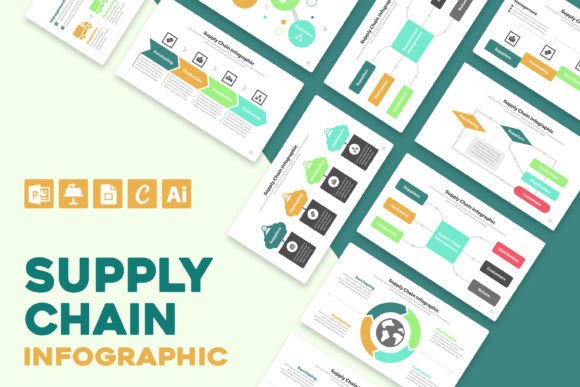
The beauty of using a specialized design asset like a Supply Chain Infographic Template lies in its ability to humanize a technical process. When you look at a well-designed logistics diagram, you aren't just seeing boxes and arrows; you are seeing the flow of collaboration. These templates are designed to show how people work together to create products. They illustrate the "who" and the "how" behind the scenes. Whether you are a project manager trying to identify bottlenecks or a marketing team explaining your company’s efficiency to investors, a visual breakdown provides immediate context.
Think about the modern business landscape. We are dealing with global sourcing, just-in-time inventory, and complex vendor relationships. Trying to track all your supplies down the line using a spreadsheet can be overwhelming. A visual template transforms that data into a narrative. It creates a tailored solution that fits your company’s specific needs, allowing you to highlight exactly where your value is added. It is not just about decoration; it is about strategic communication.
Design Versatility and Professional Polish
One of the biggest hurdles in creating custom graphics from scratch is the time investment. You might spend hours aligning shapes or searching for the right icon set. This is where the "Instant Download" feature of premium assets changes the game. When you have access to professional, clean designs right out of the box, you can focus on the strategy rather than the pixel-pushing. These aren't just static images; they are fully editable environments.
Imagine you are working in Adobe Illustrator for a high-end print report, but your colleague needs the same data in PowerPoint for a quick client meeting. A robust template package bridges that gap. It allows for seamless transitions between formats like PPTX, Google Slides, Keynote, and EPS files. This consistency is vital for brand identity. You want your typography, color palette, and iconography to look the same whether it is on a projector screen or a printed brochure. Using a template ensures that your visual hierarchy remains intact across all platforms.
Practical Applications for Creators and Businesses
So, who actually uses these? The audience is broader than you might think. It ranges from small business owners managing their own inventory to large-scale graphic designers working on corporate reports. For the entrepreneur, a supply chain infographic is a fantastic tool for pitching to potential partners. It shows you have a handle on your operations. For the content creator or blogger, it serves as a highly shareable piece of content that drives traffic and establishes authority in the niche.
Furthermore, these templates are essential for internal training. Onboarding new employees often involves explaining complex workflows. Instead of handing them a dense manual, you provide a visual guide that breaks down the roles and responsibilities. It makes the information digestible and memorable. The visual representation of the industry’s diverse workforce helps in creating an inclusive environment where every role is seen as a critical part of the whole.
Editing and Customization: Making It Your Own
A template is only as good as its editability. The best assets are 100% editable, meaning you can change every shape, color, and text element. If your brand uses a specific shade of blue or a particular sans serif font, you need to be able to apply that instantly. The inclusion of links to free fonts is a practical touch that saves you from hunting down typefaces after purchase. It ensures that the design looks exactly as intended the moment you open the file.
When you open these files in your preferred software, look at the structure. Good infographic templates are organized logically. They use layers and groups effectively so you aren't digging through a mess of objects to find a single text box. This attention to detail in the file organization reflects the professionalism of the design. It allows you to mix and match elements. Maybe you like the layout of one slide but the color scheme of another. A flexible template allows you to cherry-pick the best parts to create a unique composition that serves your specific narrative.
Strategic Storytelling Through Layout
The layout of a supply chain graphic does more than organize data; it tells a story. A linear flow implies a straightforward process, while a circular layout might emphasize sustainability or a closed-loop system. When selecting your template, consider the story you want to tell. Are you emphasizing speed? Look for dynamic lines and bold, modern typography. Are you emphasizing reliability and trust? You might opt for a structured grid layout with a more stable, serif-inspired aesthetic.
Remember that the goal is to guide the viewer’s eye. You want them to understand the journey from start to finish without confusion. The use of numbered representations for people and roles, as seen in high-quality templates, is a smart design choice. It simplifies complex human interactions into manageable data points. However, you must balance data density with white space. Cluttering the slide with too much information defeats the purpose of the infographic. Trust the negative space provided in the template; it gives the content room to breathe and makes the key takeaways pop.
Final Thoughts on Utility
Ultimately, investing in a high-quality Supply Chain Infographic Template is about efficiency and clarity. It is about respecting your audience's time by presenting information in a format that is easy to consume. Whether you are preparing a boardroom presentation, designing a white paper, or creating educational content for your website, having a reliable set of design assets at your fingertips is invaluable. It elevates your brand, streamlines your workflow, and ensures that your message is not just seen, but understood.